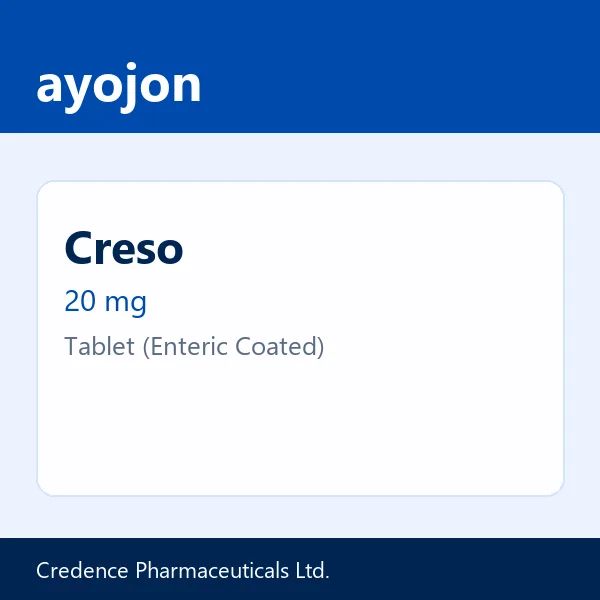



Generic: Esomeprazole | Dosage Form: Tablet (Enteric Coated) | Manufacturer: Credence Pharmaceuticals Ltd.
Indications
Esomeprazole is indicated:
- To relieve from chronic heartburn symptoms and other symptoms associated with GERD
- For the healing of erosive esophagitis
- For maintenance of healing of erosive esophagitis
- In combination with amoxicillin and clarithromycin for eradication of Helicobacter pylori infection in patients with duodenal ulcer disease.
- Zollinger-Ellison Syndrome
- Acid related Dyspepsia
- Duodenal & Gastric ulcer
Dosage & Administration
Oral dosage form-
- Healing of Erosive Esophagitis: 20 mg or 40 mg Once Daily for 4-8 Weeks. The majority of patients are healed within 4 to 8 weeks. For patients who don't heal after 4-8 weeks, an additional 4-8 weeks of treatment may be considered. Maintenance of Healing of Erosive
- Esophagitis: 20 mg Once Daily (Clinical studies did not extend 6 months).
- Symptomatic GERD: 20 mg Once Daily for 4 Weeks. If symptoms do not resolve completely after 4 weeks, an additional 4 weeks of treatment may be considered.
- Helicobacter Pylori eradication: Triple Therapy to reduce the risk of Duodenal Ulcer recurrence-Esomeprazole 40 mg Once Daily for 10 days, Amoxicillin 1000 mg Twice Daily for 10 days, Clarithromycin 500 mg Twice Daily for 10 days.
- Zollinger-Ellison Syndrome: The dose is 20-80 mg once daily. The dosage should be adjusted individually and treatment continued as long as clinically indicated.
- Acid-related Dyspepsia: 20-40 mg once daily for 2-4 weeks according to the response.
- Duodenal ulcer: 20 mg once daily for 2-4 weeks. Gastric ulcer: 20-40 mg once daily for 4-8 weeks.
IV Injection or IV infusion:
GERD with Erosive Esophagitis-
Adult Patients (≥18 years):
- 20 mg or 40 mg once daily
- IV Injection: >3 Minutes, IV Infusion: 10-30 minutes
Pediatric Patients (1 year to 17 years)
- Body weight <55 kg: 10 mg Once daily
- Body Weight ≥55 kg: 20 once daily
- 1 month to <1 year: 0.5 mg/kg once daily
- IV Infusion: 10-30 minutes
Risk reduction of rebleeding of Gastric or Duodenal Ulcers following therapeutic endoscopy in adults-
Adult Patients (≥18 years)
- 80 mg
- IV Infusion: 30 minutes, followed by a continuous infusion of 8 mg/h for a total treatment duration of 72 hours.
Interaction
Esomeprazole is extensively metabolized in the liver by CYP2C19 and CYP3A4. In vitro and in vivo studies have shown that Esomeprazole is not likely to inhibit CYPs 1A2, 2A6, 2C9, 2D6, 2E1 and 3A4. No clinically relevant interactions with drugs metabolized by these CYP enzymes would be expected. Drug interaction studies have shown that Esomeprazole does not have any clinically significant interactions with phenytoin, warfarin, quinidine, clarithromycin or amoxicillin.
Esomeprazole may potentially interfere with CYP2C19, the major Esomeprazole metabolizing enzyme. Co-administration of Esomeprazole 30 mg and diazepam, a CYP2C19 substrate has resulted in a 45% decrease in clearance of diazepam. Increased plasma levels of diazepam have been observed 12 hours after dosing and onwards. Esomeprazole inhibits gastric acid secretion. Therefore, Esomeprazole may interfere with the absorption of drugs where gastric pH is an important determinant of bioavailability (e.g., ketoconazole, iron salts and digoxin).
Co-administration of oral contraceptives, diazepam, phenytoin, or quinidine do not seem to change the pharmacokinetic profile of Esomeprazole.
Combination Therapy with Clarithromycin: Co-administration of esomeprazole, clarithromycin, and amoxicillin has resulted in increases in the plasma levels of esomeprazole and 14-hydroxyclarithromycin.
Contraindications
Esomeprazole is contraindicated in-patient with known hypersensitivity to any of the formulation.
Side Effects
The most frequently occurring adverse events reported with Esomeprazole include headache, diarrhoea, nausea, flatulence, abdominal pain, constipation and dry mouth. There are no difference in types of related adverse events seen during maintenance treatment upto 12 months compared to short term treatment.
Precautions & Warnings
General: Symptomatic response to therapy with esomeprazole does not preclude the presence of gastric malignancy.
Information for patients: Esomeprazole capsules should be taken at least one hour before meals. For patients who have difficulty swallowing capsules, one tablespoon of applesauce can be added to an empty bowl and the Esomeprazole capsules can be opened, and the pellets inside the capsule carefully emptied onto the applesauce. The pellets should be mixed with the applesauce and then swallowed immediately. The applesauce used should not be hot and should be soft enough to be swallowed without chewing. The pellets should not be chewed or crushed. The pellet/applesauce mixture should not be stored for future use. Antacids may be used while taking esomeprazole.
Overdose Effects
A single oral dose of Esomeprazole at 510 mg/kg (about 103 times the human dose on a body surface area basis), has been lethal to rats. The major signs of acute toxicity are reduced motor activity, changes in respiratory frequency, tremor, ataxia, and intermittent clonic convulsions. There have been no reports of overdose with Esomeprazole. No specific antidote for Esomeprazole is known. Since Esomeprazole is extensively protein bound, it is not expected to be removed by dialysis. In the event of overdosage, treatment should be symptomatic and supportive. As with the management of any overdose, the possibility of multiple drug ingestion should be considered.
Storage Conditions
Store at a temperature not exceeding 30°C in a dry place. Protect from light and moisture. Keep out of reach of children.